Region and Wander · 6 min
Avignon Street Art, what the walls of the old town tell us

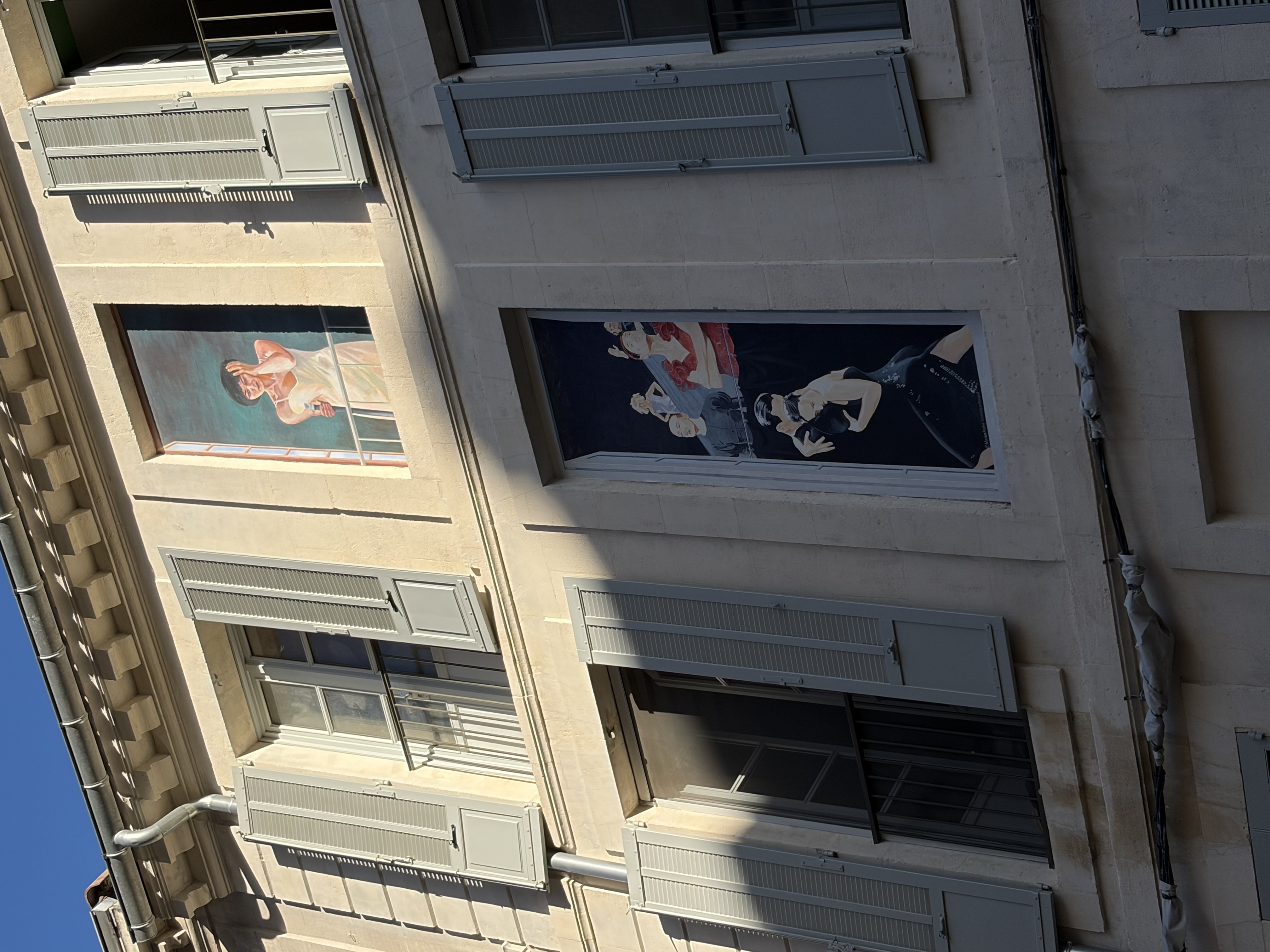
A woman in a grey gown leans against a house wall, almost life sized, her hands folded in her lap, her head set against a dark semicircle. The paint sits directly on the old plaster, in some places it is already flaking off, and that is exactly where the image becomes interesting. Avignon Street Art is not a poster hung up after the fact. It grows out of the wall, it ages with it. In this series of photographs you can see how closely the painted figure and the weathered surface belong together. Whoever walks through the old town with open eyes reads the city by its surfaces.
Why Avignon Street Art belongs to the wall, not in front of it
Look at the large figure in the first image. The gown is painted in calm shades of grey, with fine folds, the collar of small round buttons sits neatly across the chest. Beside it the raw wall, beige lime plaster, washed out by the light, with cracks and patched spots. Where the painting ends and the plaster begins there is no hard edge. The paint follows the unevenness, it settles into the hollows, and in one place a whole layer has come loose and reveals the layers beneath.
That is the point. A painted figure on a house wall in Provence looks entirely different from the same motif on a smooth gallery wall. Here the patina joins in. The wall already has a life behind it before the figure came, and it will go on living long after the figure has faded. This simultaneity of new and old is what you feel in Avignon on so many corners.
Beside the image a few olive branches reach into the frame, above it a wrought iron sign, a stretch of street with shops behind. None of it is arranged. It is city, and the painting stands right in the middle of it, not cordoned off, not labelled. You walk past, you lift your gaze, and there it is.
The figure in the passage, when material and image merge
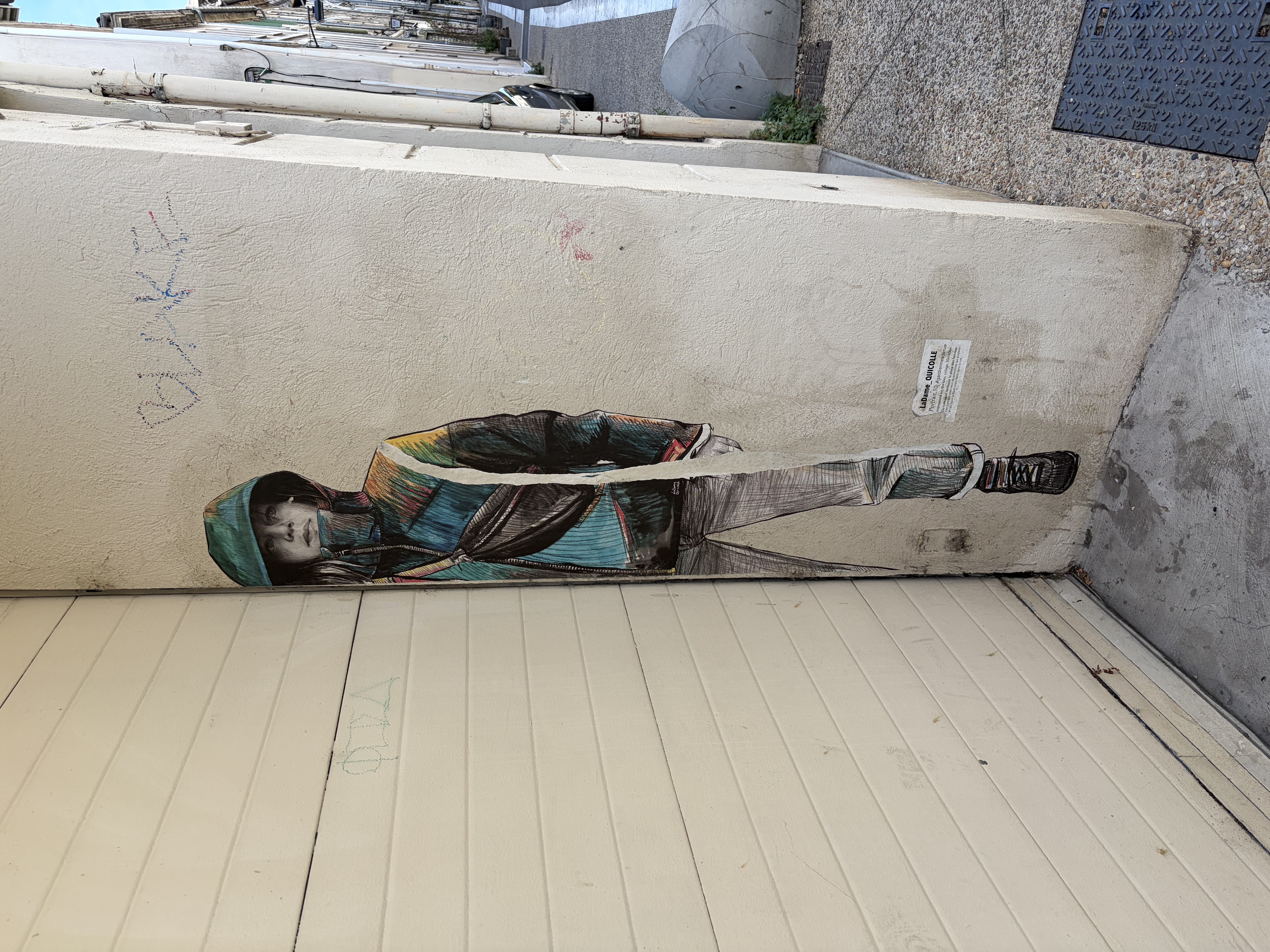
In the second photo a different kind of wall image. A figure in a hooded jacket, the face young, the gaze lowered, the clothing in teal and warm earth tones, finely hatched like a drawing. The legs in jeans, the shoes worked out in detail. It does not lie flat, it seems rather glued on and merged with the wall, in one place the paper tears open and the bare plaster shows through.
That is the technique that makes so many wall images in the old town so vulnerable. They are stuck onto the plaster, they are thin, and they survive only as long as the wall lets them. Moisture, sun, a flaking layer, and a piece of the figure is gone. Some find that a pity. I like the opposite. These images do not claim to last forever. They belong to the city like a poster that slowly fades, except that here someone worked by hand.
The surface here too is a coarse, beige lime plaster, slightly curved, with little scribbles and a stuck on note beside it. Below, wooden boards or a pale panelling, above, pipes and concrete. A sober place, a passage, not a stage. And that is precisely where the appeal lies. The figure is not waiting for an audience. It is simply there, for whoever looks.
A sky of cloths, colour against concrete
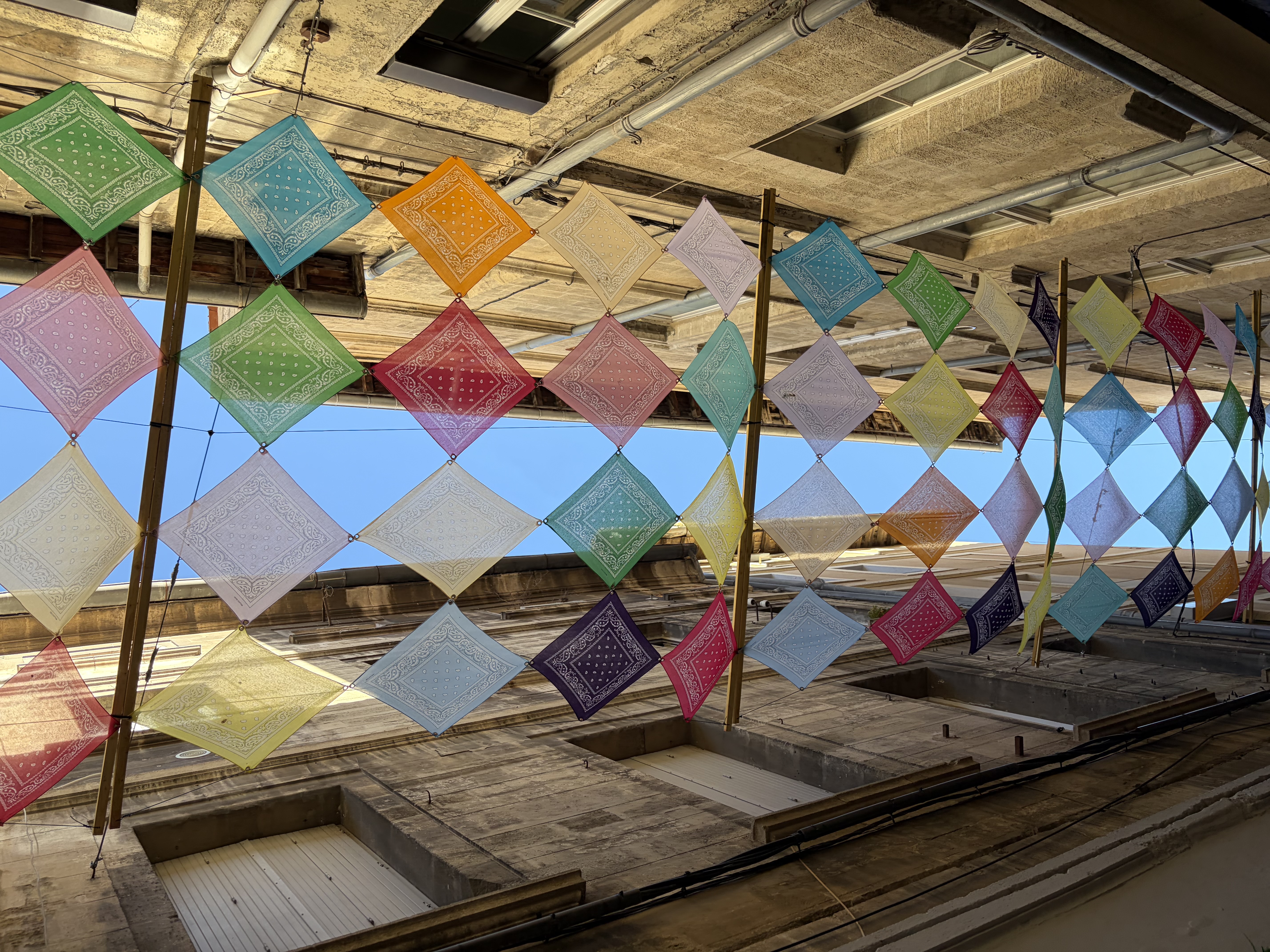
The third image opens upward. Over a narrow lane, cords are stretched from facade to facade, and from them hang countless cloths in a chequered pattern, set on their points. Green, pink, orange, turquoise, lilac, each with the typical paisley and dot print. The sun shines through, the light breaks the colours apart, some glow strongly, others have already faded to soft pastel tones.
In between, the concrete of the houses, grey ceilings, old cornices, pipes, dark window openings. The contrast is the whole idea. Above the sober, weathered material floats a roof of fabric, light and fleeting, that moves with every breath of wind. This too is a form of street art, only not painted but hung. It changes the lane for a season and is then gone again.
What I like about this series of photographs is the range. From the calm, almost devout figure to the fragile drawing to the cheerful sky of cloths. Three very different interventions, and all three share the same attitude. They take the city as it is, with its rough walls and its hard light, and lay something light over it. They claim nothing, they invite.

How to read a city by its surfaces
Provence is a country of surfaces. Lime plaster that grows softer over the years. Travertine and marble on thresholds. Wooden shutters bleached in the sun. Brick and stucco, washed out, patched, painted over. Whoever walks here with open eyes sees layers everywhere, and street art is only one more of them. It settles on top and becomes part of the patina itself.
That is exactly why wall painting works so well in this region. The surface is never neutral. It has texture, it has history, it has a light that makes everything warmer and a little more tired. A painted figure on a concrete wall in a new development would only be an image. Here it becomes a piece of the wall, with all the cracks and patches that belong to it.
I like the thought that none of it has to be perfect. The paint flakes off, the paper tears, the cloths fade. That is not a flaw, that is the character. This very love of material, this trust that a thing grows more beautiful and not uglier with time, is something I find again across the whole region. In the houses, in the furniture, in the streets.
If you are interested in this connection of material and atmosphere, in our showroom and apartment in Provence you will find rooms built from the same attitude. How these observations pass into living spaces we show at martinarogy.com, without much explanation, simply through the built example.
Street art as part of the walk, not as a destination
I like Avignon Street Art best when it does not become a programme. No list, no ticked off tour. You walk through the old town, you seek shade, you turn into a narrow lane, and suddenly a life sized figure stands on the wall and looks at you. Or you glance upward because the light falls so strangely, and there hangs a whole sky of colourful cloths.
These moments cannot be planned. They happen when you are slow enough. The city rewards strolling, stopping, going back because something only catches your eye on the second look. The finest wall images rarely hang on the great squares. They sit in passages, on side walls, where the plaster is roughest and the light most honest.
What remains is not the single image but the feeling of having read a city rather than merely photographing it. The woman in the grey gown, the young man in the hood, the cloths over the lane. Three images, one day, and on every corner the same promise. Look more closely, and the wall tells you something.
Frequently asked
Where can you find street art in Avignon
Scattered across the old town, above all in narrow lanes, passages and on side walls away from the great squares. You find it best while strolling, when you walk slowly and lift your gaze upward too.
Why does the paint on many wall images flake off
Many images sit directly on old lime plaster or are thinly glued on. Sun, moisture and the weathered surface all join in, so they fade and come loose over time. This very impermanence is part of their character.
Are the colourful cloths over the lane street art too
In a broader sense, yes. It is a temporary installation of hung cloths that changes a lane for a season. It is not painted, but it shares the same attitude, laying something light over the sober material of the city.
Is a walk worthwhile just for the wall art
It is more a lovely side effect than a destination. Whoever walks through the old town and pays attention to surfaces, plaster and light discovers the images by themselves. As a pure sight it works less well, as part of a slow wander very well.